
Book Launch
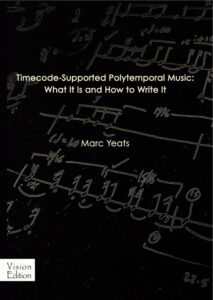
November sees the publication of Marc Yeats’ new book, Timecode-Supported Polytemporal Music: What It Is and How to Write It, published by Vision Edition and available through Composers Edition.
Performed without a conductor, click-tracks or a traditional score, timecode-supported polytemporal music allows players to interpret their respective tempos individually, with parts loosely synchronised using mobile phone stopwatches. In his recent update, Marc explains the motivations behind this innovative style, revealing a creative philosophy rooted in flux, freedom, and the structure of natural forms.
Timecode-Supported Polytemporal Music: What It Is and How to Write.
My work with timecode-supported polytemporal music began as an attempt to transcend the limitations I encountered in traditional orchestral notation. Finding no models that addressed what I wanted to achieve, I devised my own approach—timecode-supported polytemporal composition. Over the course of more than a decade, this became the focus of my research, culminating in 2021 with the completion of my AHRC-funded PhD thesis, ‘Control, Flexibility, Flux and Complexity: A Timecode-Supported Approach to Polytemporal Orchestral Composition’. At its core, the aim was straightforward: to give every orchestral instrumental voice the freedom to move independently, shaped by self-borrowed, temporally unrelated materials, while still holding together as a coherent and structurally resilient whole in performance.
Polytemporal music, for me, is about freedom. Each musician becomes a soloist, performing at their own tempo, enjoying unique expressive and interpretive possibilities. Using timecode and stopwatches, performers align loosely, producing results that are structurally coherent yet never the same—recognisable but always different, much like the morphing formations of starlings. I think of this elasticity as ‘soft focus’, a term borrowed from photography, where form and detail are visible but blurred and never perceptually fixed. This philosophy not only informs my compositional methods but also permeates my work as an expressionist painter and poet, reflecting our changing world.
I often think of my orchestral compositions as landscapes for aural exploration, while looking at the mark-making in my paintings or walking by the coast evokes sound responses in my imagination. These are all embodied experiences. They share a sense of polytemporality in how they unfold over time, with the simultaneously different speeds of layers of experience perceived and assimilated in the moment and across a lifetime. Such thought processes, simultaneously unfolding at various speeds, are commonplace. For example, when thinking about shopping lists or conversations while driving along a motorway, or focusing on composing a letter while walking, the body automatically and without awareness navigates the path, preventing one from falling over.
Together, these embodied experiences cause a cross-fertilisation feedback loop. One form of artistic expression inspires development in another. Singular inputs like sight, sound, or touch generate multiple outcomes. This enables me to create work in different media from the same stimuli, as explored in my 2024 book Music, Painting, Landscape and Me.
In that book, I explain how I move between music, painting, and textual forms, all drawn from identical somatic, emotional, and perceptual stimuli. Through ‘mapping’ processes informed by neuroscience, philosophy, semiotics, quantum mechanics, and fuzzy logic, I interconnect these with landscape and my own embodiment to uncover universal insights into creativity, perception, and meaning-making.
Recognising varied sensory perceptions and interpretive freedoms in engaging with symbolic abstractions, this work bridges my intentions and audiences’ interpretations across transduced expressions. It transcends subjectivity by capturing shifting perspectives, overlapping rhythms, and blurred contours, thereby manifesting each medium’s polytemporality. In this way, form emerges through multiplicity and transformation rather than rigid control, while inviting ongoing dialogues on artistic practice and fostering appreciation for the fluid intersections of human experience and expressive modalities across disciplines.
Artists are naturally curious about the hows and whys of creation, even if those processes aren’t always straightforward. Some feel driven to explain them personally. While I covered many facets of my compositional approach in Music, Painting, Landscape and Me, certain techniques demand deeper exploration, and this new book is my attempt at further elucidation. Both a theoretical and practical guide, it introduces the origins of timecode-supported polytemporal composition, explains how timecode enables independence without conductors, click tracks or conventional scores, and places ‘sonic flux’—the small misalignments concerning the vertical placement of sounds along a composition’s timeline that arise when players interpret tempos individually—at the centre of the discussion. Rather than eliminating flux, I explore how to contain it so it enriches local detail without undermining global structure.
Key chapters examine notation, rhythm perception, performer coordination and the redefined roles of conductor, score and orchestra. The book also guides readers through the whole creative process, from concept development and computer modelling to creating performance materials and evaluating the final performance.
Timecode-Supported Polytemporal Music: What It Is and How to Write It invites composers, performers and curious readers alike to explore the creative potential of this methodology. It offers essential tools, adaptable techniques and a philosophy that embraces fluidity, complexity and freedom—an approach as layered and changeable as the natural world that inspires it.
You may like to watch the BBC Scottish Symphony Orchestra perform the world premiere of my spatialised timecode-supported polytemporal composition, a point in the landscape, at Tectonics Glasgow 24 by clicking here.
Timecode-Supported Polytemporal Music: What It Is and How to Write is available here.
You may also be interested in Music, Painting, Landscape and Me and Collected Poems: Volume One, also available from Composers Edition.
For more information about my music, visit here.
If this article has inspired you to support my work as a composer, please visit my Music Patron page here to learn how you can contribute.