
Finally time to bite the bullet on writing what is probably the final piece of the ‘Prehistory’ cycle I’ve been working on for much of this year. The project, for Stephanie Lamprea (soprano) and Richard Craig (flutes) reflects on aspects of Scotland’s early peoples (i.e. Neolithic, Bronze Age and Iron Age) through the materials they used for everyday existence: bone, skin, wood, metal, stone, air. It was funded by Creative Scotland and we’re recording the full 45-50 minute cycle in December for release mid-2026.
I wrote the following lyric early in the process, and it’s gone through a few revisions since then while I wrote the other pieces. It imagines the complex and varied procedures required in the preparation and execution of bronze-making, and outlines a chain of consequences and materials needed with a single goal in mind (but also some welcome by-products).
Metallurgist
I fell the ash
for charcoal and a spear.
I kill a stag.
Dig the earth for clay with its shoulder blade.
I form its antlers: one a knife to scrape the ore,
one a whistle and a beater.
I stretch its skin around a frame and make
a bellows to urge my charcoal into flame.
I grind my ore to powder with a heavy stone.
My clay I wet to shape
And fire a mould for bronze;
I hang the meat to dry above the forge.
© Stuart MacRae 2025
The initial composition process can be seen in the below image – several layers of textual analysis and musical preparation. Most of this is mentally absorbed in the act of writing it down, and more or less ignored when I actually begin the composition process: I’ve been doing this so long now that I can trust that whatever is important has been internalised and will emerge unconsciously when I am in the flow of composing. It’s important not to overthink! (Even if overthinking was absolutely a necessity for pieces I wrote when I was younger…)
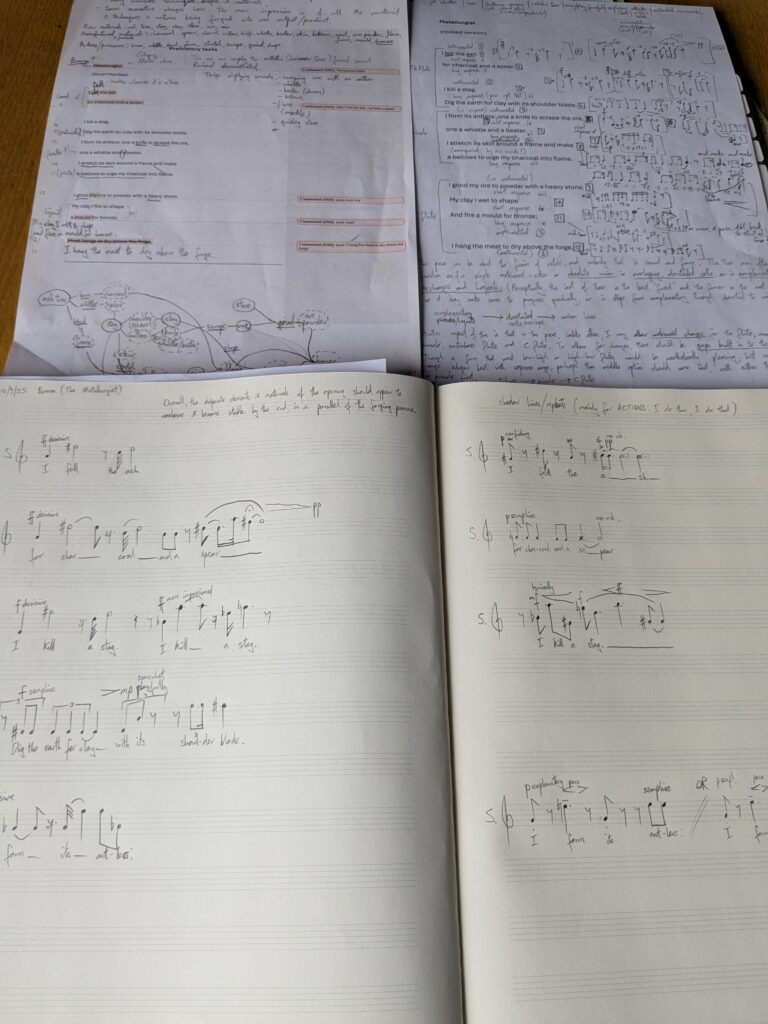
In the lower part of the image is a more specific and revised version of the vocal lines sketched on the printed poem. This is my usual way of working with text, especially in operas: to write my initial musical response to it on the printed page, with rhythms, contours and intervals, where I hear them specifically, expressed as +/- a number of semitones, then refine and revise it later. In this way I create a word-setting that feels strongly connected to the words and their character, but is flexible enough to adapt to the emerging musical context when other elements (instruments, harmonies, textures, motifs) are added.
The next stage (which overlaps with the last one in steps) is to input a more final version of the vocal line into Sibelius, and to write the other elements, in this case a highly involved flute part. As I do this, the vocal line bends and adapts to respond to its timing, harmony and pitching are adjusted, and the whole thing is in flux until both parts are written.

On this project I have the great advantage of being able to workshop closely with the performers before finalising the music. So what you see above is a first draft that even the performers have not seen yet! Once I’ve shown it to them, things are likely to change somewhat, to find the right balance of practicality/playability, timing etc. but the essence of the music will be the same. I will also revisit this draft to look at whether additional techniques, embellishments and dynamics could enhance the music’s character. The challenge here is to create the impression of a ‘multilayered’ work with only two instruments over the huge span of 50 minutes, hence the apparent complexity of the score and process. That’s why I consider it all the more important to write the first full draft fairly quickly and fluently (in no more than a few days) before returning to refine and develop as required later.
I hope this insight into my process for this piece is interesting – admittedly some of it may be a bit technical, but composing is nearly always a balance of intuition and technique, knowledge and expression, planning and spontaneity, all finished off with as much practicality as possible without compromising the essential vision of the music. (You may notice the omission of ’emotion’ from the above list: composing itself is not, for me, an emotive process; but the ideas and intentions behind the work are intricately bound up in the emotional worlds from which they arise, and if the composition is well-realised, the emotions will speak).
As you can see, it’s a time-consuming and involved process at times, which is one of the reasons I am grateful for all the support I get from my patrons.
Anyway, enough procrastination, and back to work for me!
Stuart