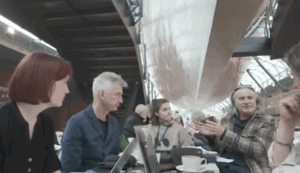
It’s a Monday afternoon at the end of March. I’m sat around a table underneath the massive underbelly of the Cutty Sark, Greenwich with four wonderful musicians. I’m a stones throw away from the meridian line and the epicentre of British maritime history.
We’re discussing a new piece, Ocean Songs, to be performed in the brand new floor of the National Maritime Museum. It’s first performance will be in just over three months, and we need to compose a whole album of songs, record it, and rehearse it for live performance. All around me there are excited ideas be tossed around and avenues opening up to be explored; underwater recording with hydrophones, ships bells, community choirs, scientific data to map to notes, lectures about the environment to sample, sounds of underwater creatures, and granular synthesis to morph sounds of shrimps. It’s fascinating. It’s very exciting. And so rich in possibilities.
But as the woven voices bounce around me in this uber-resonant acoustic, all I can think of in this sea of ideas is that we have and incredibly short space of time to come up with the notes, formulate a coherent overall design, capture as many of the concepts as needed, and to keep everyone creatively on board. (Pardon the pun). There had been talk of creating the music through a process of collaboration with me instigating musical responses and piecing things together. It’s something I’d done during the pandemic with an album called Isolated Pieces, and it seemed to work. Suddenly it seems very clear to me that there needs to be a cleaner and more streamlined approach. An innate sense of pragmatism from many years working in testing circumstances shouts to me that I need to take creative control and act quickly, otherwise this project could flounder in a very messy way. There will be no room for dilly-dallying. No room for precious indulgent exploration.
I spend the next ten days back home sketching out the nine songs that are to form the album. Delivering these one at a time to the team won’t work. People need to see an overall vision and the songs need to exist collectively. Most of the songs are rapid extemporisation to capture a mood and a musical style, and are built from sounds to hand. A few are adaptions from my stockpile of ideas lurking in Logic folders and in note books. I travel back to London and present the complete album to Nic (co-director of the project). I think he’s shocked and impressed in equal measure. For me this is a huge relief, but its only stage one of the journey.
https://soniccollaborations.com/?i=1
It feels as if I’m using the full range of my skills as a composer on this. On one level I’m managing the expectations and skill-sets of the team (given that time is slipping away fast), but I’m also creating work that draws together the many areas of work that I’ve previously explored. My experience as a song-writer is at the fore, creating demos for our singer Lottie. I’m simultaneously imagining how instruments might get processed, and how this might work live. I’m juggling the arrangements in terms of parts that are notated and parts that will allow for improvised elements later. An important strand of the music is the inclusion of a community choir. I need to keep an eye on this. The schedule tells me that the three songs to include the choir need to be finished first so that scores, realisations and explanations can all go to the choirs so that they can begin rehearsing as soon as possible. These songs have a six week turnaround!
So the weeks pass by. I exchange ideas with Lottie (our singer). I send her the framework of the songs and she sends recordings back. Sometimes it a free form approach with her writing lyrics and singing a melody. Sometimes I have some fragments of lyrics and melodies. Sometime I present a finished song of melody and lyrics. All is open to adaption, and the main purpose of this part of the process is for Lottie to get invested in the material and to inhabit the world being created. She is the singer, and as such this strand carries much of the essence and personality of each song. This is a gradual process ebbing and flowing between us, and it can’t be rushed. I’m keen that there is no sense of anxiety, or pressure from me. We adopt the same approach for her guitar parts too.
https://www.youtube.com/watch?v=DrgDRRVQNEk
Simultaneous to this I’m soliciting ideas from Steve (trumpet) and Nic (electric viola) by drip-feeding frameworks to them also. With Steve, there are huge delays and four weeks before the first performance I really only have a response to one song. With Nic he is less fluent with extemporising and a realise that to get this across the line I must compose all the notes. Both of them have very heavy commitments elsewhere and I remain as patient as I can
The first rehearsal is on Wednesday 18th June. For this I need to have created scores and parts for every player, formulated my own keyboard sounds, plus created a backing track and click tracks. With a flurry of audio files coming back from Steve and me tweaking the album mix, the week leading up to this is hectic.
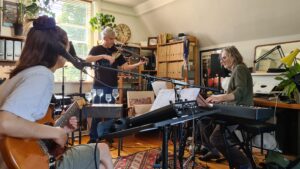
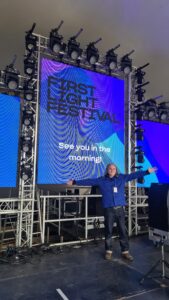
We premiere some of the songs on Lowestoft beach at dawn. 4.30pm, and my music is blowing around, sand is blowing into the keyboard, and I can hardly see a thing because it’s so dark!. Then we play the main stage on the same beach, part of the First Light Festival. It’s a magnificent event, and all free. A few weeks later we play at the National Maritime Museum, (back where the ideas all began) on the hottest day of the year. Another great concert, and a huge sense of relief that it’s all worked.

https://www.youtube.com/watch?v=YnD66-oGU4Y
Some things I create take years to be completed. Some are done in an adrenaline rush of pressure. Ocean Songs is virtually done, and it’s taken a lot out of me. There’s the final edits of the album to do and then this it will be released in the Spring. I can now get back to the piece that had been on my mind for the last three years and complete this. This one is a slow-burner! A piece celebrating the song of the blackbird (engaging with AI) for string quartet.