
2025 was a really interesting year for my practice. I’m not sure if I should call it the Year of the Magnet or the Year of the Exoplanet…! I worked on a variety of different ideas, but concentrated into a few key projects – which I’ve found is the way I like to operata.
If there’s one major takeaway, though, it’s this: Build Time To Not Be 100%
I had some really severe health problems in 2024. That’s all fine now but the point is, it took me out of action for a while. I know exactly how long it takes me to write music (more or less) and I hadn’t accounted for this time in my composing schedule, which I set years in advance. So, in 2025, I was scrambling to meet deadlines for almost the entire year, all of which was a knock-on effect from 2024. It’s not nice to miss literally the whole summer because you’re working flat-out, and it’s never good to feel like you should have had more time on a project. Getting ill wasn’t my fault, but it was a mistake to assume I can always work at 100% and plan accordingly.
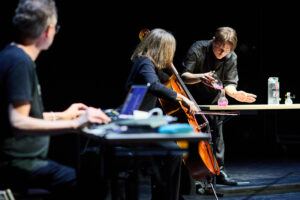
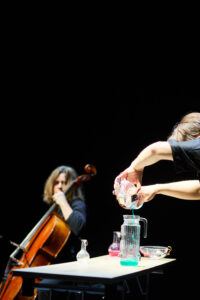
2025 started out with a performance I designed called The Four Elements performed by Federico Visi, Cosima Gerhardt and Alberto de Campo in Berlin. This was actually a text score, and the instrumentation was a set of liquid-pouring vessels which control sonic neural networks, a cello, and electronics. Bonkers! I don’t do many text scores, but I’m increasingly interested in graphic notation as a means to explore creative expression with emerging technologies. This project is part of my ongoing interest in embedding neural networks and other “AI” technologies into physical objects or instruments which can allow musicians (or non-musicians) to make intuitive music using this technology. This area of my work has really become increasingly important over the last year or two – more on it later. You can read more about this project here https://www.robertlaidlow.co.uk/vessels
In March, Stephanie Lamprea gave her fifth performance of Post-Singularity Songs, my half-hour bizarro song cycle for soprano and electronics which I wrote for her in 2023. I’m so grateful to Stephanie for continuing to sing it and ,in fact, she and Alastair MacDonald recorded it onto their album “Ecstatic Visions”, which will be released early next year. I’m looking forward to sharing this excellent quality recording with everyone then.
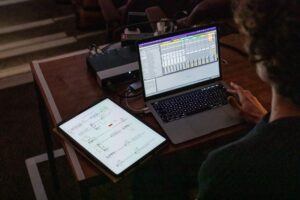
Speaking of albums, March also saw me in the studio with the Piatti Quartet, recording my string quartet Gravity for my own upcoming debut album with NMC. The Piattis played sensitively and with buzzing energy, so I’m also looking forward to sharing this.
In May I gave a few lecture-performances relating to various projects. I gave two on “Exoplanets and Music”: one in Oxford, with the fantastic Freya Goldmark on violin demonstrating new musical ideas, and one in Basel. I also gave a talk/performance at Cafe Oto with Zubin Kanga about our collaboration on my orchestra piece TECHNO-UTOPIA. In June I gave a lecture-performance on Beethoven, AI and creativity at the Berlin Konzerthaus. This saw me working with the fantastic pianist Hanni Liang for the first time – we explored new instruments, improvised music, transcriptions and machine creativity in a jam-packed late night performance.
TECHNO-UTOPIA is a concerto for piano, synthesizers, newly-developed intelligent instruments (including one controlled by manipulating magnets) and orchestra. We recorded it in July with the BBC Philharmonic and conductor Jack Sheen. I’ve written about it on Music Patron previously, so I won’t go into details here. Suffice to say, it was really a highlight of the year and we’re bringing it to Berlin next October with the Rundfunk Sinfonieorchester Berlin.
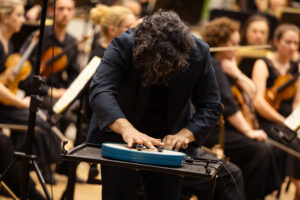
©Robin Clewley
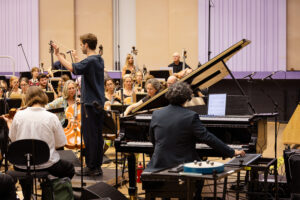
©Robin Clewley
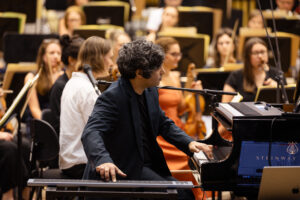
©Robin Clewley
In the Autumn, Poppy Philigreen and Johanna Leung gave my two-saxophone piece Shadow Music (from 2017) two further performances in Manchester – I’m so pleased this is still being heard! I wrote it for myself and my friend Will to perform when studying at the Royal Academy of Music.
To finish, The London Philharmonic gave the first performance of my new piece Exoplanets at the end of November. This is a huge piece for me, and quite substantial at 25 minutes. I’m so grateful to the LPO for commissioning it, and was really touched at how many people came to see the premiere. It was a real joy to work with the LPO and Edward Gardner, who are all very nice and extremely good at their jobs! I started thinking about this piece in 2022, so it’s been a little while coming. I am quite pleased with how it came out and looking forward to hearing it again next year with the Basel Symphony Orchestra.
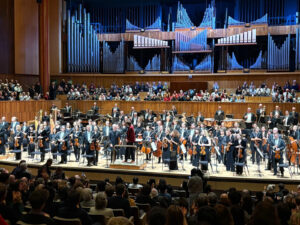
While that was my last performance, I actually began a new role at the Music Department at King’s College London just two days later. This has literally just happened, but I’m delighted to join such a fantastic department and have the chance to pursue my research in the centre of London.
So that’s the year. I doubt many people will get this far into this post – if you did then, well, thanks and see you in 2026!