
Composer and cellist Jo Quail and her patrons on creativity, community, and why new music matters.
In the history of music, the relationship between a composer and their audience has rarely been simple. It has involved distance, reverence, and often a one-way flow – of sound from stage, of applause from the dark.
Music Patron was founded on a different idea: that through collective regular giving, music lovers could become patrons of composers they believe in – composers selected on the basis of artistic merit and given complete creative freedom to make exciting new music for public audiences. In return, patrons are invited closer. And their presence changes what becomes possible.
This is the story of what happens when that idea works.
Jo Quail: Composer, Cellist, Community Builder
Jo Quail is an internationally acclaimed composer and cellist based in London, whose music defies easy categorisation. Combining virtuosic cello playing with innovative looping and electronics, she performs solo and with orchestras and bands to audiences across Europe and beyond. Her work has been described as ‘one of the most awe-inspiring and inventive’ of her generation. She is currently preparing to perform her album ‘Notan’ – newly arranged for five trombones – at ArcTanGent Festival later this year.
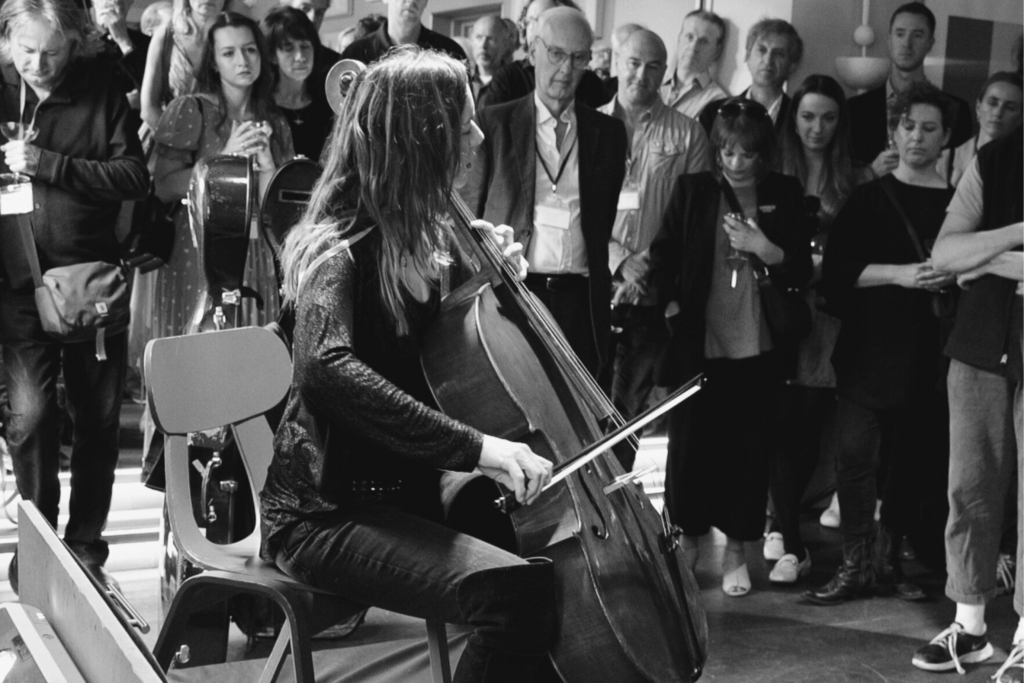
She is also one of Music Patron’s most committed advocates. And what she describes about the experience of being supported through the platform extends far beyond the much-needed funding derived from her patrons’ monthly donations.
“It’s incredibly difficult to articulate, because having these beautiful people with me is beyond something that I ever thought was possible. Prior to this, I could never talk to people about what actually goes into creating a piece of music – the joys and the highlights and the absolute gruesomeness sometimes. And these people are kind enough to offer their time to me for this. Everything I put out is as much to do with them as it is to do with my creativity. It’s a massive team effort.”
– Jo Quail, composer and cellist
The Community Around the Music
Jo convenes regular Zoom calls with her patrons – a group of music lovers from the UK and beyond, ranging in background and expertise, united by a deep investment in her work and the creative process more broadly. These are not passive supporters. They are, in Jo’s words, her team.
Bob, a retired engineer, first encountered Jo at a festival in Belgium, where he spent the evening photographing her performance rather than his nephew’s band. He joined Music Patron because she invited him, and stayed for something he hadn’t anticipated.
“Jo puts out pieces for us to listen to, and we have the opportunity to hear things at the stages of their development – to try to understand the logic and the thought or the emotion behind it. This keeps me involved in a way that otherwise just isn’t there.”
– Bob, patron
Sarah, another patron, describes the calls as something qualitatively different from other ways of supporting an artist – a direct, tangible contribution to the conditions that make creation possible.
“I believe in cycles. For something that gives me so much, there’s an opportunity to put back. By being a patron, I know I’m directly helping Jo to carry on creating – that the next record could happen, that the next musician could get paid. That’s a really important avenue. And even if we didn’t have these sessions, I’d still do it.”
– Sarah, patron
For Jay, the relationship with Jo’s music arrived at a critical moment in his life. What began as a profound personal connection to her work deepened, through Music Patron, into a friendship that has stayed with him.
“Five years ago, I was in the darkest place anyone could be. The music saved my life, basically. And then the friendship changed my life.”
– Jay, patron
Jock, who has spent twenty-five years working in mental health and knows first-hand what music can do for people in difficulty, recognises something similar in what Music Patron makes possible.
“It connects me in a unique way – like a secret peek behind the curtain of creativity. Music has always been there for me, through celebration and adversity. To be able to support one of my favourite artists, even in a small way, and to think my contribution might mean more music is made – that’s just the coolest thing in the world.”
– Jock, patron
Another patron who came across Jo through a concert venue newsletter and bought a ticket on the strength of the word ‘cello’ alone, puts it with characteristic directness:
“Although I don’t have a musical background, it’s quite fascinating to experience the creation path – how a piece emerges and develops, the motivations, how all the artistic and technical elements are carefully weighed. I confess a lot of it disintegrates when I eventually listen to the finished piece because I tend to lose myself completely in the music. The meanings and intentions do stick, though.”
– Anonymous patron
Making the Music
What becomes clear, spending time with this community, is that the line between supporter and collaborator is intentionally blurred. Not in the sense that patrons direct Jo’s work – the creative vision remains entirely hers – but in the sense that their presence, curiosity, and honest responses shape the conditions in which that vision develops.
Composers on the platform welcome the discipline and accountability that comes with engaging with their patrons: the act of articulating their process to people who are genuinely curious about it sharpens their own thinking, prompts reflection, and can open up new directions they might not have found alone. For Jo, this is not just theoretical.
At a recent patron call, Jo played an early version of ‘First Rain’, newly transposed for trombone quintet for her performance at ArcTanGent. Jane raised a technical point about key and intonation for slide instruments. Andrew urged Jo to preserve the purity of the original piano version before letting the trombones build. Bob imagined a structure that could begin and end with percussion. Jo took notes. When she played the rough mock-up – stripped of dynamics, phrasing and reverb, a work-in-progress in every sense – the room lit up anyway. Sarah’s response captured the mood:
“Main Stage is going to pop off with four trombones playing that! That’s going to be sick… Oh, buzzing!”
– Sarah, patron
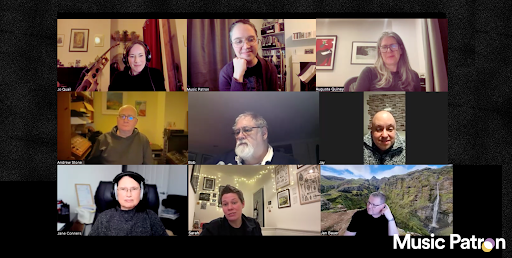
Jo describes the experience of having that kind of sounding board as genuinely formative – not a process of following instructions, but of being heard and challenged in equal measure. She recalls how, for one substantial new work, she played two possible endings without revealing which she preferred. Her patrons were unequivocal about which one worked and, more importantly, why.
“That ending is an absolute banger now. Every time I get to that bit, I think of you lot – because when we first listened to it, it was practically a piano sketch. You knew where it needed to go, and you gave me the confidence to nail my colours to the mast.”
– Jo Quail
What This Means for New Music
Music Patron’s model rests on a clear principle: that public access to new music of genuine artistic merit is a public good worth investing in. Composers are selected for the platform through a rigorous application process and assessed by a panel of specialists. Their support is conditional on continued creative output, and new work must be made publicly available.
As Jane who joins from the United States observes, it is a meaningfully different proposition from the open-access platforms that dominate elsewhere – one where curation is the point, not an afterthought:
“With something like Patreon, anyone can sign up. There’s no vetting of whether that person has a following or whether they are what they say they are. Music Patron does that upfront – it makes a difference to know [the composers] are doing what they say they’re doing, and the community that builds around them is actually valid.”
– Jane, patron
When Jo performs ‘First Rain’ at ArcTanGent this summer, the audience will have no idea that the arrangement was shaped in part by conversations on a Zoom call. They won’t know that Bob suggested a structure that begins and ends with percussion. They won’t know that Jane’s advice about the key opened up new options. They will simply hear the music – extraordinary new music – reaching new audiences and made possible by a new kind of patron support.
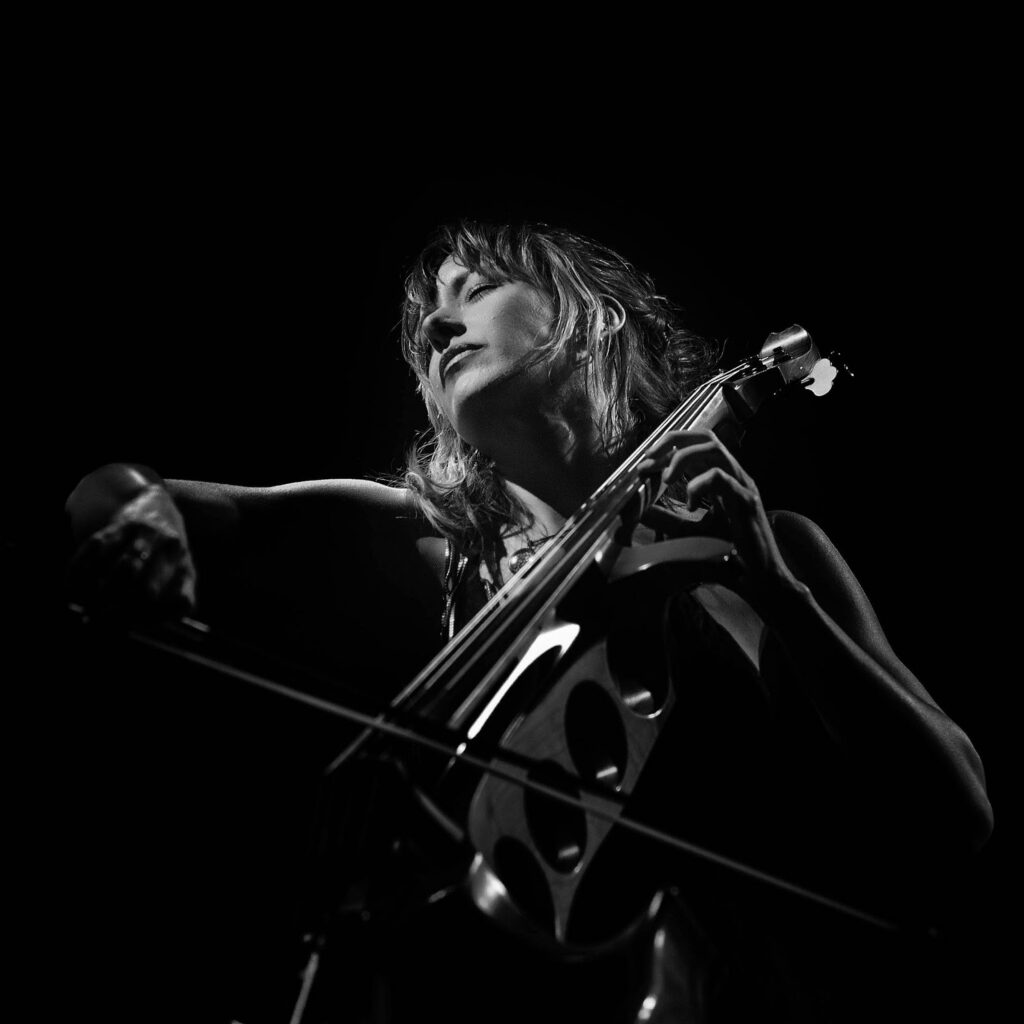
Photograph: Nick Hodgson
Sarah put the broader cultural argument plainly:
“As it becomes harder to differentiate between what’s been made by a human and what’s been made by a machine, this is a really lovely way to propagate authenticity. You can join this platform either as someone who is creating, or someone who wants to support creation – and know that you’re on the right side.”
– Sarah, patron
Jock frames the stakes with the clarity of someone who has seen what connection and creativity can do for people:
“Art is what keeps us human. Listening is about finding connections and empathy. We need that more than ever right now. Supporting artists to create is something I feel really proud of.”
– Jock, patron
Across the community, people who might never otherwise have met have discovered shared passions and built lasting friendships. Jan, who supports other artists through similar models, returns each month for the same reason as everyone else:
“The feeling that I can give back something to an artist who gives me so much is very important to me. To give an artist the chance to produce new music – to give you something which is why you came across this artist in the first place – that’s what really matters.”
– Jan, patron
And at the centre of it all, Jo Quail – performing to sold-out venues across Europe, preparing new orchestrations, sending backstage dispatches from small green rooms in various cities – who perhaps has the most honest summary of what it means to do this work with people behind you:
“It takes a hell of a lot of people to compose a piece of music. I’m just the thing that sits on the front of the ship – and everybody else is rowing.”
– Jo Quail
Music Patron is a UK charitable platform that supports the creation and appreciation of new music by connecting composers with patrons through an innovative new model of collective patronage.
To find out more or become a patron, visit musicpatron.com/support